


Lu Bingbing talks about Hydrogen 2.0: Opening up the non automotive track, how can hydrogen powered drones go?
On October 20th, industry media Gaogong Hydrogen Electric published an article onJiehe TechnologyExclusive interview with General Manager Lu Bingbing. This in-depth interview, titled "Attack and Defense," focuses on the development cycle of the fuel cell industry and highlights a pointThe current market with a small scale but a clear outline: hydrogen powered drones.
“Why is it a hydrogen powered drone?
Lithium ion unmanned aerial vehicles have been trapped for a long timeShort endurance, limited load capacity, and insufficient lifespanThree major pain points that are difficult to satisfyElectricity inspection, maritime patrol, etcLong term homework scenarios. And fuel cells happen to solve these problems from the root:
First,Long battery lifeThe short range of lithium batteries is a fatal weakness, while the energy density of fuel cells is much higher than that of lithium batteries, which can significantly extend flight time and meet the needs of long-term operations;
Second,Heavy load capacityAs the powertrain system of unmanned aerial vehicles, fuel cells have an overall energy density far exceeding that of lithium batteries, and can provide greater power at the same weightPayload capacity;
Third,Long service lifeThe overall service life of fuel cell systems is better than that of lithium batteries. Although lithium batteries have lower one-time procurement costs and single energy replenishment costs than fuel cell drones, if the total flight mileage and flight hours throughout the entire lifecycle are included in the calculation and converted to unit voyage mileage and unit voyage hours, fuel cells have more economic advantages.

For practitioners in the drone industry, cost is only a second level issue. The key to determining whether a product can be "successful" lies in whether it has the technical feasibility verified and whether it hasA comprehensive solution with high reliability, durability, and comprehensive after-sales serviceOnce this system is implemented, there is considerable room for substitution.
“How can Feirui take on this track opportunity?
The opportunity for low altitude tracks lies not in the breakthrough of a single power component, but in the coordinated implementation of a complete closed-loop solution.
In August of this year, at the first National Hydrogen Drone Application Challenge, equipped withThe Feiruide FR50 hydrogen powered unmanned aerial vehicle of Jiehe Hydrogen Fuel Cell System won the championship in one fell swoopWe have completed the practical verification of industrial inspection scenarios.
Both parties have also reached a strategic cooperation agreement and will collaborate on the research and market of hydrogen powered dronesPromote 1000 sets of hydrogen powered drones within three years, with an estimated shipment volume of 100 units by 2026.
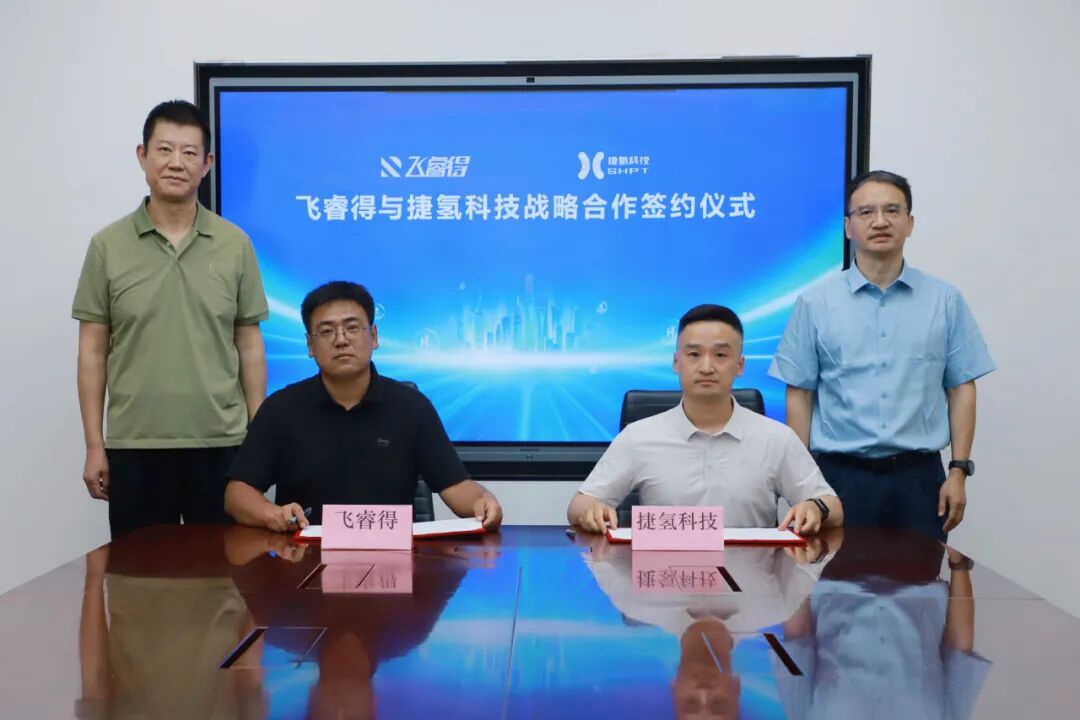
Feirui hasSelf developed flight control - Nebula Ruikong, andRuizhijing Hydrogen Unmanned Aerial Vehicle Application PlatformSynchronize LayoutHydrogen refueling operation and maintenance supporting systemMature with Jie Hydrogen OutputFuel cell powerWe complement each other's capabilities and work together to create a highly reliable, durable, and closed-loop hydrogen unmanned aerial vehicle solution.
“Hydrogen powered drone race track: rational perspective, returning to the scene
Hydrogen powered drones will not completely replace lithium-ion dronesIt's not zero sum competitionBut insteadScene complementarityIt mainly focuses onLong endurance, heavy load, and special environmentWaiting for high-value industrial scenarios.
At present, the main focus of commercialization is on aircraft models with a takeoff weight of less than 25kg and no airworthiness certificate required,eVTOLCargo transportation comes first, while passenger transportation is still far away. The hydrogen powered drone race also needs to abandon short-term explosive fantasies,Adhere to scene driven approach and refine products through projects.
The tide recedes, and industry competition is no longer about concepts, but about implementation. Just like the idea of Jiehe Hydrogen:Do not blindly pursue scale, do not force subsidies to retreat, drive down the cost of fuel cells and systems, and settle the manufacturing processThis coincides with the development strategy of Feiruide:Concentrate on polishing the FR50 series models, accumulate data, improve products, iterate solutions through continuous testing and application, and wait for industry opportunities.
In the future, Feiruide will continue to work with Jiehe to deploy hydrogen powered low altitude equipment in real operational scenarios such as mountains, coasts, and deserts.